Migrant Camps Strain Ceuta as 140 Die in Border Crossing
Local leaders in the Spanish enclave report that 13,000 to 15,000 undocumented immigrants remain in temporary shelters, testing the city's historic religious coexistence.
By Aisha Bello ·
At least 140 people died on July 30 when approximately 70,000 undocumented immigrants crossed from Morocco into the Spanish exclave of Ceuta. Residents described the event as an avalanche. Local estimates indicate that between 13,000 and 15,000 of those migrants have not returned to Morocco. They currently live in temporary camps with limited resources.
Ceuta is home to roughly 84,000 residents, nearly half of whom are of Moroccan descent. The influx has created pressure on the southernmost neighborhoods. In the industrial area of Tarajal, migrants occupy makeshift shelters that lack electricity and running water. Karim, a local volunteer who requested anonymity, reported that conditions are dire. He said residents have been beaten by security forces at night.
Prime Minister Pedro Sánchez blamed disinformation campaigns linked to Israel and Russia for part of the crisis. Independent fact-checkers and Spanish intelligence found no evidence to support those claims. José Bentolila, president of Ceuta’s Jewish community, agreed that the allegations are unfounded. He views the situation as a domestic policy challenge rather than an external attack.
The local Jewish community numbers about 300 people and has been shrinking for decades. Bentolila attributed the decline to young people moving to the Spanish mainland for better employment. Many families, including his own, sent their children abroad for education. This has led to an aging population within the community. Historically, Ceuta served as a model of peaceful coexistence among Christian, Muslim, Jewish, and Hindu groups. For decades, Muslims celebrated Hanukkah with Jewish neighbors, and Jews participated in Ramadan observances.
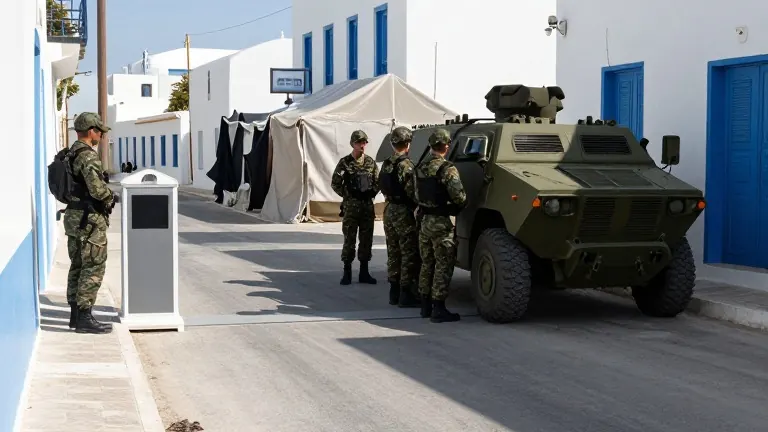
Daily life in Ceuta has changed due to the presence of migrants. Army patrols now seal off the city center to prevent unauthorized entry. Soldiers carrying assault rifles stand near key landmarks, including the Bet-El Synagogue. Alegría, a resident who spoke under a pseudonym, expressed frustration with the government's handling of the migrants' legal status. She questioned why they were not arrested or deported.
Piedad Abecasis, a member of the Jewish community, noted that the congregation is becoming more Orthodox. New dress code signs at the synagogue reflect this shift. She observed that autumn rains worsen conditions in the migrant camps, causing some groups to scatter into the city center. This has generated growing anger among locals.
Isaac Medina, a municipal official nearing retirement, does not view the migrant influx as a direct threat to the Jewish population. He acknowledged that security has been heightened around the synagogue, with military vehicles parked across the street. Medina drew a parallel to German Jews in the 1930s. He warned that if Jews feel unsafe, they tend to leave and take their belongings with them.
The crisis has become a major issue in Spain's national election scheduled for November 29. Polling shows declining support for Sánchez's Socialist Party. The conservative Partido Popular and the anti-immigration Vox party are gaining ground. A majority of Spaniards now rate the government's handling of the Ceuta crisis negatively. Over 80 percent favor stronger border controls. Kissy Chandiramani, vice president of Ceuta’s autonomous government and a Hindu, blamed the national government for the situation. She argued that Spain is being treated unfairly in dealings with Morocco. She highlighted the Jewish community as a symbol of the city's diverse identity. She stated that if any of the four major religious groups were to disappear, the unique character of Ceuta would be lost.